KIUC Business Hours: Monday - Friday, 8 a.m. - 4 p.m. (excluding holidays)

Public Safety Power Shutoff
PSPS preemptively de-energizes power lines during high-risk conditions, such as high wind events combined with hot and dry weather conditions. More specifically, in order to protect KIUC’s system, its employees, its members/customers and the general public, KIUC may decide it is prudent and/or necessary to pre-emptively de-energize power lines in response to a condition determined by the co-op to be hazardous and/or in the interest of public safety.
CURRENT ACTIVE PSPS EVENTS: None
Image
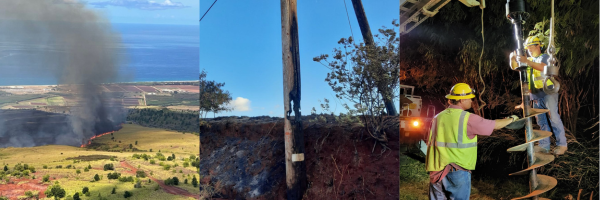
Please take the time to learn more about PSPS and how you can be prepared for such an event.
PSPS preemptively de-energizes power lines during high-risk conditions, such as high wind events combined with hot and dry weather conditions. More specifically, in order to protect KIUC’s system, its employees, its members/customers and the general public, KIUC may decide it is prudent and/or necessary to pre-emptively de-energize power lines in response to a condition determined by the co-op to be hazardous and/or in the interest of public safety.
When considering this type of operation, KIUC examines the impacts on fire response, water supply, public safety, and emergency communications. KIUC also considers the external risks and potential consequences of a PSPS while striving to meet its main priority of protecting the communities and members/customers we serve. They include, but are not limited to:
Potential loss of water supply to fight wildfires due to loss of production wells and pumping facilities that rely on electricity.
Negative impacts to emergency response and public safety due to disruptions to the internet and mobile phone service during periods of extended power outages.
Loss of key community infrastructure and operational efficiencies that occur during power outages.
Medical emergencies for members of the community requiring powered medical equipment or refrigerated medication. Additionally, the lack of air conditioning can negatively impact medically vulnerable populations.
Negative impacts on medical facilities, fire, police, and schools.
Traffic congestion resulting from the public evacuation in de-energized areas can lengthen response times for emergency responders.
Negative economic impacts from local businesses forced to close during an outage.
The inability to open garage doors or motorized gates during a wildfire event.
The risks and potential consequences of initiating a PSPS are significant and extremely complex. However, in facing any disaster or a potential disaster, KIUC’s highest priority before, during and after a natural disaster or emergency event is the safety of its employees, its members/customers and the public. As a result, KIUC must reserve the option of implementing a PSPS when conditions dictate.
KIUC understands that poor communication during an emergency can further contribute to injury, property damage, and even death. In an effort to mitigate and avoid this, KIUC has developed protocols to ensure that appropriate and actionable information reaches all concerned stakeholders in a timely manner.
Whenever feasible, KIUC will begin notifying its members/customers approximately 72 to 48 hours in advance of a potential PSPS event, and will as soon as practical issue additional alerts and updates as the situation develops. Announcements will be made once the power has been deenergized, throughout the outage, and when power has been restored. There may be situations that prevent KIUC from providing advance notice. For example, the actual or sudden onset of extreme weather or hazardous conditions and other circumstances beyond the co-op’s control may impact coordination and notification efforts.
Information regarding the PSPS or other unplanned outages will be shared with stakeholders as soon as feasible to allow for the maximum amount of time to prepare and respond. During these times KIUC will utilize the following channels of communication:
- KEMA (Kauai Emergency Management Agency)
- Communications companies attached to or collocated with KIUC infrastructure
- News media outlets serving the affected areas
- KIUC’s mass email distribution list
- Instant, concurrent mass notification via email, phone and text via Everbridge subscription service
- KIUC’s social media accounts (Facebook, Instagram)
- Prominent postings on KIUC’s website (www.kiuc.coop)
- Talking points provided to KIUC member services representatives
- Direct calls to key accounts and identified special needs members
- KIUC’s online “Outage Center”
Residential Customers
Ensure KIUC has your most current contact information on file (phone, email and SMS/text): Call us at 808-246-4300 to update your contact information.
Build your outage supply kit. Recommended items include:
- First aid kit
- Bottled water
- Flashlights
- Batteries
- Nonperishable food
- Manual can opener
- Battery-operated radio
- External rechargeable battery pack
- Special-needs items for infants, elderly, or disabled
Prepare your home
- Keep important phone numbers (emergency hotlines, hospital, doctor, relatives, etc.) where they can be found easily in an emergency.
- Place flashlights and battery-powered lanterns in handy locations around your home.
- Install surge protectors to help safeguard electronic equipment.
- Get acquainted with your home’s utility boxes (electricity, water, and gas), and learn how to turn them off. Make sure you have easy access to the necessary tools to do so.
- Frequently back up important work and files on your computer.
- Learn how to manually open your automatic garage doors or gates.
- Keep the gas tank or charge level in at least one car half full (minimum) at all times.
- Identify an outdoor location where you can safely use a backup generator. Never use a generator indoors.
- Review your family safety plan regularly, including how you’ll address the needs of infants, the elderly, people with disabilities, and pets.
Businesses
Ensure KIUC has your most current contact information on file (phone, email and SMS/text): Call us at 808-246-4300 to update your contact information.
Create a workplace preparation checklist. Suggested items for the checklist:
- Make sure all on-site employees know how to manually operate security gates.
- Develop a business continuity plan that defines roles and responsibilities for each employee during an emergency.
- Create a list of equipment that must be turned off during an outage to prevent damage or possible danger.
- Know how to turn off utilities (electricity, water, and gas). Make sure you have easy access to the necessary tools to do so.
- Identify and inform all staff of an off-site meeting area in case you need to evacuate.
- Identify an outdoor location where you can safely use a portable generator. Never use a generator indoors.
Customers With Medical Needs
If you or someone in your care has a condition that requires medication or life support systems, or if your medications require refrigeration, contact your medical provider on how to handle emergencies and power outages.
Make sure you have submitted KIUC's form that alerts us that a person in your household has electricity-dependent medical needs. You may also submit this form if you are age 62 or older, or have a disability.
The U.S. Centers for Disease Control and Prevention (CDC) recommends:
* Throwing away any refrigerated medication if the power has been out for a day or more, unless the label on the medication directs otherwise.
* If medications have been at room temperature but a life depends on the refrigerated medication, use only until a new supply is available.
* Replace all refrigerated medications as soon as possible.
General safety
- Stay away from downed power lines.
- Use alternative light sources like flashlights or battery-powered lanterns instead of candles.
Electronics and appliances
- Unplug household appliances such as televisions, computer equipment, washers, dryers, game consoles, fans, and lights to prevent them from being damaged.
- Use surge protectors to help prevent damage to electronics.
- Turn off all light switches and lamps except for one. You’ll want to leave one on so you’ll know when power returns.
Food safety
- Keep the refrigerator closed, opening doors only when necessary.
- For outages lasting more than two hours, food items such as dairy products, meats, fish, poultry, eggs, and leftovers should be packed into cooler with ice.
Generator safety
- Before using a portable generator, be sure to read and follow the manufacturer's instructions. Take precautions to avoid poisoning from the generator's toxic exhaust and to prevent electric shock, electrocution, and fire.
Elevator safety tips
- To the extent possible, avoid using elevators after you’ve been notified that a PSPS event is imminent.
- Press the “open” button if you’re near a landing when the elevator stops. Exit carefully as the elevator may not be level with the landing.
- Press the “alarm” or “help” button to notify trained emergency personnel.
- Remain calm and call for help or bang on the elevator door every few minutes to attract attention.
- Wait for help. Do not attempt to exit through partially opened doors or the ceiling service door. Wait for trained emergency personnel to arrive.
What to Do AFTER a PSPS
- Check all foods kept in a refrigerator or cooler before cooking and consuming. For the latest recommendations on food safety, visit the U.S. Department of Agriculture and the State of Hawaii Department of Health.
- Safely turn off your generator.
- Once power has been restored, check equipment, and gradually turn on essential items.
- For customers with rooftop solar and/or battery systems that are not working after a PSPS, please consult your solar contractor to find out how to check and reset the main control panel.
- Your household controls electric service through a panel or box called a circuit breaker panel or fuse box. Circuit breaker panels or fuse boxes contain breakers or fuses of different capacities. If power has been restored to your neighborhood after a PSPS, but some or all of your power is still not functioning in your home, check your circuit breaker to see if any of the fuses have been tripped and need to be reset.